GIAC GREM Certified!
It’s been a little while since my last post, and that’s because I’ve been heads-down working toward a big goal: earlier this year I sat for the GIAC Reverse Engineering Malware (GREM) certification, and I’m excited to share that I achieved it, two days before the end of the year, in fact!

Before we get into the rest of this post, I want to be clear about something: per the GIAC Candidate Agreement and Exam Integrity Policy, I’m limited in what I can share about the exam content itself. That means I can’t publish specific questions, answers, or anything that would reveal confidential material from the test. What follows is my personal experience, high-level observations, and lessons learned from taking the exam.
Why I Specifically Pursued GREM
Reverse engineering and malware analysis has always held a particular fascination for me, not just because it’s technically deep, but because it bridges the gap between theory and real-world offense and defense. My background in security has involved a mix of incident response, tooling, development, and analysis, and I’ve long wanted to formally validate the part of my skill set that lets me look inside malicious code rather than just observe its effects.
Reverse engineering malware isn’t just about understanding how something everything around an attack in the first place, it’s about understanding why the attack even happened, how adversaries built it, and how I can translate that knowledge into stronger defenses, more accurate incident response insights, and more credible threat research. The GREM certification aligned with that goal: it’s a credential that demonstrates whether you can safely, methodically, and accurately dissect malicious software, which is a skill set that’s \ necessary in advanced security roles and research functions.
About the GREM Certification (High-Level)
The GIAC Reverse Engineering Malware (GREM) certification is a practical validation of your ability to analyze malware behavior, understand its structure and intent, and apply hands-on techniques to interpret and dissect malicious code. The certification is designed for security professionals who protect organizations from malicious software by going beyond logs and alerts into the actual inner workings of malware.
This credential confirms your capability to perform static and dynamic malware analysis, interpret Windows assembly and API patterns, and get meaningful insights from real samples, all in the context of incident response, forensic investigation, or threat research. The examination validates not just what you know, but how you apply that knowledge in controlled environments to extract actionable understanding about malicious code.
My Study Approach
My preparation for the GREM exam started with the official, on-site six-day training class that laid the foundation for everything that came afterward. Once the class ended, I committed to a study rhythm that became part of my daily routine: no matter where I was or what else I had going on, I spent at least an hour each day reviewing all of the course materials, redoing labs, and refining my personal index of concepts and tools. Even while traveling, I stuck to that schedule; many late nights went into reinforcing and internalizing what I learned.
To solidify my understanding, I leveraged every opportunity to teach the material to others. Training and presenting on malware analysis forced me to learn the concepts in a way that wasn’t just passive, it made me explain and contextualize them clearly and practically. In addition to the official labs, I built and used my own isolated lab environment to work with live samples (handled safely, of course) so I could practice applying techniques outside the structured course settings. I even experimented with writing simple malware myself so I could better understand the mindset and mechanics behind malicious code.
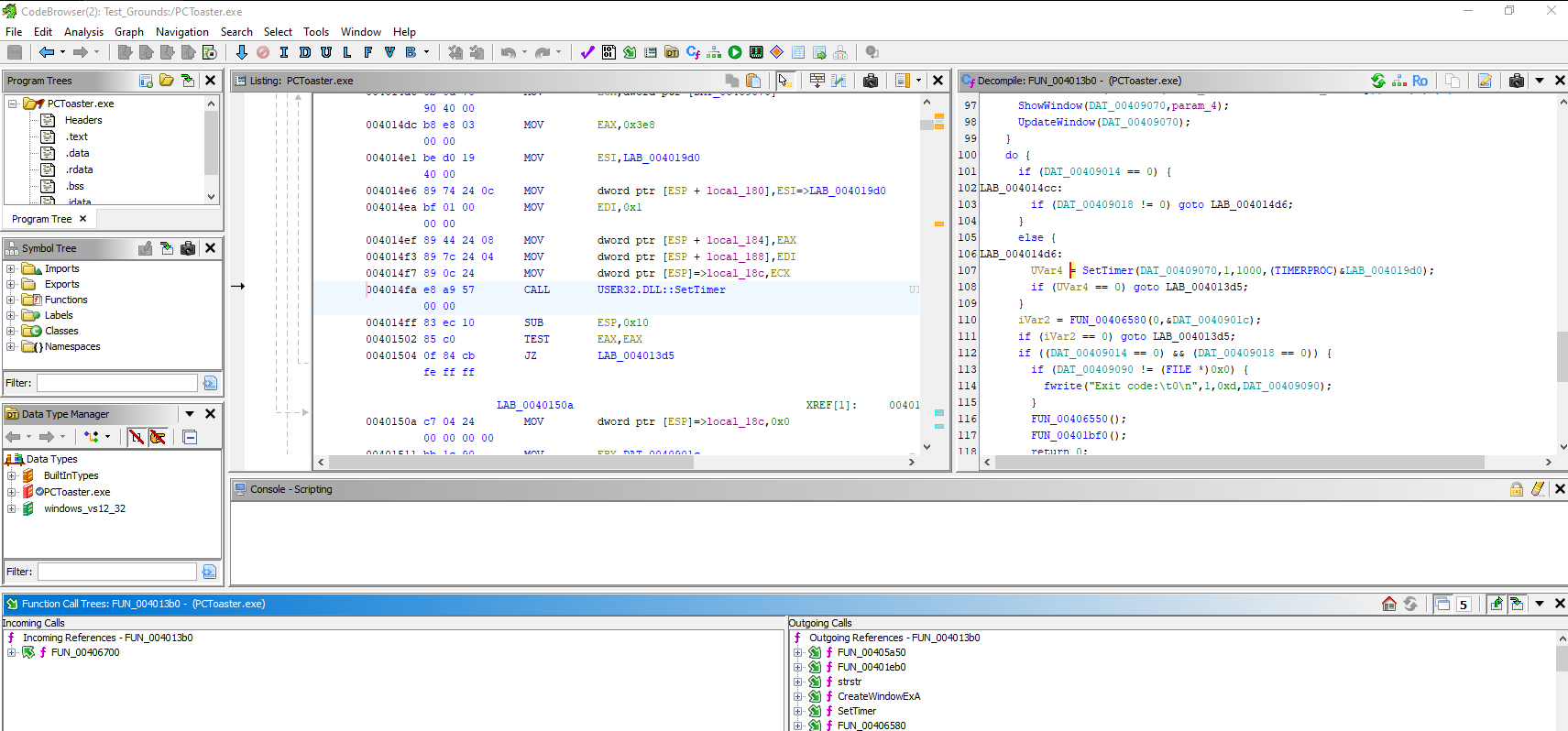
Analyzing a sample in my personal lab
As exam day approached, I shifted into a more intense preparation mode. I took three practice tests as a way to familiarize myself with testing logistics and to evaluate where my index needed refinement. Over the course of my studies, I went through multiple iterations of my index to make sure it was truly a resource I could rely on. In those final weeks, my study time increased to at least two hours per day, and I made a concerted effort to revisit challenging topics until they felt second nature.
On exam day, I did my best to keep it simple: some last review of my notes, eating a good breakfast, and some controlled breathing throughout the day.
The exam has a time limit of 3 hours, and I clocked in at 2:59:35. Yep.
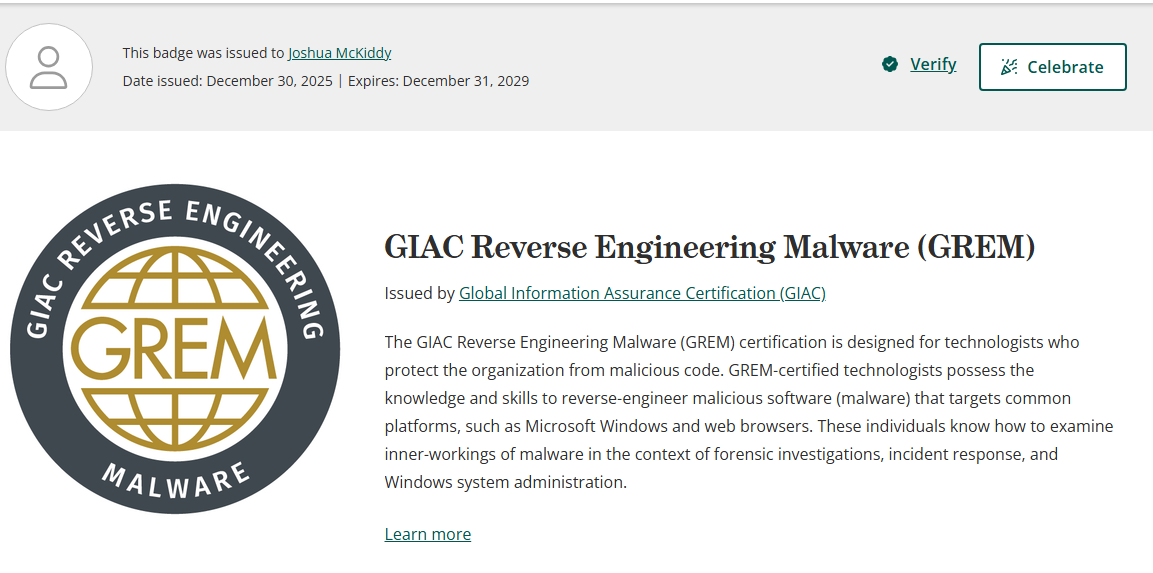
We got it done.
Lessons Learned and What Really Prepared Me
What this journey reinforced for me is that mastery of principles matters far more than memorizing isolated facts. When you understand why a technique works or a pattern appears, you can apply that knowledge across contexts and investigations. Real-world malware case studies were useful in this regard as well; working through samples and dissecting behavior in a laboratory environment helped make abstract concepts tangible and memorable.
Another thing that stood out to me was the role of ethical conduct in malware analysis. Handling malicious code carries responsibilities. Responsible disclosure, safe lab practices, and an ethical mindset are just as critical as technical chops when you’re operating at this level. This exam and the preparation for it didn’t just validate my skills, it reinforced the professional standards that go with them.
What This Means for My Work
Earning the GREM certification is significant to me because it is proof of expertise I’ve been building over years of hands-on security work. It complements my existing skills of incident response, tooling, development, and security research.
Where incident response often looks outward at effects and outcomes, malware reverse engineering looks inward at intent and mechanics. Combining the two gives a more holistic view of security events: not just “what happened,” but “how and why it happened.” That perspective enhances my ability to investigate, defend, and even anticipate threats in ways that are grounded in both theory and practice.
Closing Thoughts
Passing the GREM exam was both challenging and rewarding. Beyond the technical knowledge validated by the certification, the process reaffirmed for me the importance of disciplined study, hands-on practice, and ethical professionalism in cybersecurity. If you’re considering GREM or any GIAC certification, go into it with curiosity, persistence, and humbleness.
A review of the tips I’ve mentioned:
· Make a study schedule (1 hour minimum per day) and stick to it.
· Start prep soon after training so the material stays fresh.
· Create and refine a detailed index you can use during the open-book exam.
· Reread books, highlight key concepts, and organize your index to find info fast.
· Redo labs and hands-on exercises.
· Use practice tests to get familiar with the exam format and timing.
· Focus on understanding principles, not just memorizing facts.
· Review weak areas more than topics you already know well.
· Treat the exam as open-book, bring well-prepared notes and resources.
· Practice real analysis techniques in your own lab to reinforce skills, if available.
If you’re taking the exam, good luck and have fun!
